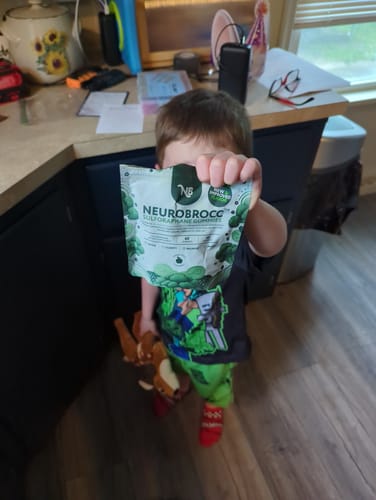
Why Thousands of Parents Are Giving Their Kids "Broccoli Gummies" — And What Researchers at Johns Hopkins Found That's Leaving Speech Therapists Speechless





When Amanda's 4-year-old son Ethan still wasn't talking, she'd already tried everything. Speech therapy twice a week. Occupational therapy. Supplements her pediatrician recommended. Even an elimination diet that lasted three miserable months.
"I felt like I was failing him," Amanda admits. "Every other kid at daycare was having conversations, and my son couldn't say 'mama.'"
Then his speech therapist mentioned something Amanda had never heard of: sulforaphane.
"She said, 'There's this compound in broccoli that researchers at Johns Hopkins studied in children with autism. The results were significant.' I went home and read everything I could find."
That night, Amanda ordered NeuroBrocc — a gummy supplement built around the same sulforaphane compound from the study.
What happened next is why you're reading this.
What Researchers Found
Here's what most parents don't know.
In 2014, researchers at the Johns Hopkins University School of Medicine, working alongside colleagues at Harvard Medical School, published a placebo-controlled, randomized, double-blind clinical trial in the Proceedings of the National Academy of Sciences.
They studied sulforaphane — a natural compound found in broccoli sprouts — over 18 weeks, with behavioral outcomes assessed using three independently validated scales.
What they found: sulforaphane supports the body's antioxidant response — specifically, it activates the Nrf2 pathway, which upregulates glutathione synthesis and helps reduce oxidative stress in the brain. In children with elevated oxidative stress markers, this pathway is often underactive.
The results: statistically significant improvements in verbal communication, social interaction, and behavior scores. When sulforaphane was discontinued, scores returned toward baseline.
The challenge?
To approach the concentrations studied, a child would need to eat roughly two pounds of broccoli every single day. For kids with sensory issues and picky eating, that's not realistic.
That's what a company called NeuroBrocc spent three years solving: a gummy that delivers a meaningful dose of sulforaphane in two small pieces — in a green apple flavor that even the most resistant eaters ask for by name.

Speech therapists are increasingly recommending sulforaphane supplementation alongside therapy.
"Within Two Weeks, His Speech Therapist Asked What Changed"
Back to Amanda.
"I was honestly just hoping Ethan would eat them because he rejects everything. But he loved the green apple flavor. He actually asks for them now."
Week 1: Amanda noticed Ethan seemed calmer. Fewer hard moments at transitions.
Week 2: His speech therapist pulled her aside after a session. "What are you doing differently? He's attempting more words." Amanda hadn't said a word about the gummies.
Week 4: Ethan said "mama" for the first time.
"I cried. I called my husband at work. I sat on the kitchen floor and just sobbed."
Amanda Is Not Alone.
Across thousands of families who've tried NeuroBrocc, a pattern keeps repeating.
The people who notice first are the ones who don't know anything has changed.
Teachers texting parents out of nowhere.
Grandparents asking what's different.
Speech therapists pulling parents aside mid-session.
Occupational therapists flagging changes before anyone says a word.
What Parents Typically Notice — And When

What parents typically report — and when. Individual results may vary.
What the Research Actually Shows About Sulforaphane and the Developing Brain
The Singh et al. trial, published in the Proceedings of the National Academy of Sciences, was placebo-controlled, double-blind, and ran 18 weeks. Behavioral outcomes were assessed by both parents and clinicians using three independently validated scales.
What the researchers found: sulforaphane activates the Nrf2 pathway, which upregulates the body’s own antioxidant defenses, including glutathione, the brain’s primary antioxidant. The researchers specifically identified oxidative stress, depressed glutathione synthesis, and neuroinflammation as factors associated with ASD that sulforaphane was selected to address.
On the Clinical Global Impression scale, a significantly greater number of participants receiving sulforaphane showed improvement in verbal communication compared to those on placebo (P = 0.007).
When participants stopped taking sulforaphane, scores on all behavioral scales rose back toward pre-treatment levels. This suggests the effect was active and ongoing, not a one-time change.
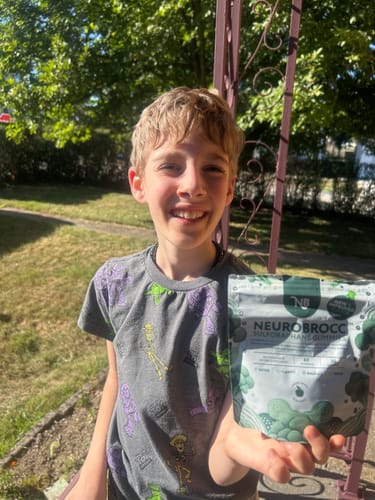
★★★★★ NeuroBrocc | Reviews: 3,196 | TrustScore: 4.9 out of 5



Why This Worked When Nothing Else Did
Most supplements fill nutritional gaps.
NeuroBrocc works differently, and it took me a while to understand why.
The reason researchers chose sulforaphane specifically is because it targets the cellular mechanisms they had already linked to brain function.
Oxidative stress. Neuroinflammation. Depressed glutathione synthesis.
These aren’t marketing buzzwords. They’re the actual findings from a published, peer-reviewed trial out of Harvard and Johns Hopkins.
What that means in plain language: this isn’t a supplement that adds something your child is missing. It supports what the brain is already trying to do.
Here’s what’s inside:
- Broccoli Sprout Extract: fast-absorbing source of sulforaphane that gets to work quickly
- Whole Broccoli Sprouts: slower digesting, so the effects last throughout the day
- White Mustard Seed: activates the enzymes that make sulforaphane usable by the body, not just present in the gummy. Most brands skip this entirely.
- Green Apple Powder: natural flavoring that makes these taste like candy. This is the reason kids ask for them by name and why the daily supplement battle ends on day one.
A note on ingredients, because I looked into this before giving it to my own kid.
The gummies contain corn syrup, which is the same thing as glucose syrup, just labeled differently depending on the manufacturer.
This is not high-fructose corn syrup. They are completely different ingredients.
And at just 2g of sugar per serving, NeuroBrocc has significantly less sugar than most children’s gummies on the market, many of which contain up to 8g.
No artificial colors, no artificial flavors, no gelatin. Just the compound that was studied, in a form kids will actually eat.
What Parents Say They Wish They'd Known Sooner
After speaking with dozens of NeuroBrocc families for this piece, one phrase kept coming up unprompted.
"I wish I hadn't waited so long."
Here is what parents said they would tell someone who is on the fence right now:
"Give it a full two to three months. Week one is subtle. Week three is when it becomes real. Month two is when it becomes undeniable."
"My only regret is not finding this sooner. We tried so many things that did nothing."
"The taste was my biggest worry. My son is SO picky. He loves them. That alone was worth it."
What Happened to Amanda and Ethan
Ethan is five now.
He tells Amanda when he is hungry. He tells her when something scared him. He uses her name when he calls for her from the other room.
When I asked Amanda what she would say to a parent who is still waiting, still trying things, still sitting on that kitchen floor, she did not hesitate.
"Just try it. You have nothing to lose. I wish someone had told me sooner."
If you have read this far, you are probably the kind of parent who does not give up easily.
You have tried things.
You have spent money.
You have sat in waiting rooms and parent-teacher conferences and therapy sessions hoping something would finally click.
NeuroBrocc is not a guarantee. No supplement is.

But it is backed by real research, loved by thousands of real families, and it comes with 60 days to find out if it works for your child.
With every cent back if it does not.
That is a reasonable ask for a parent who has already tried everything else.
Readers of This Article Save up to 42%
Because you are reading this through Health & Parenting Journal, NeuroBrocc is offering an exclusive discount to readers of up to 42% off the regular price.
This discount is not available in stores or on third-party sites.
It is only accessible through this page.
For families who want to give it the full two to three months that parents consistently recommend, there is also a three-pack and five-pack bundle.
The bundles offer the deepest savings and still come with the full 60-day guarantee.
No subscription. No auto-ship. No hidden charges.
You order what you want, when you want it.
Still Have Questions?
The three things parents most commonly ask before trying NeuroBrocc for the first time:
"What if it doesn't work for my child?"
That is what the 60-day guarantee exists for. You are not committing to anything. You are giving it 60 days to show you something. If nothing changes, you get every cent back.
"Is the science actually real?"
The trial was published in the Proceedings of the National Academy of Sciences, placebo-controlled, double-blind, 18 weeks. The finding on verbal communication improvement, P=0.007, is sourced and verifiable. The full study is available at doi.org/10.1073/pnas.1416940111.
"My child is the pickiest eater alive."
Every parent I spoke with said some version of this before they tried it. Every one of them said their child asks for the gummies now.
★★★★★
"My son went from two words to full sentences in four months. I have recommended NeuroBrocc to every parent I know in our autism support group. This is the real deal."
— Heather M. — Verified Buyer, Nashville TN
A Final Note from Sarah Mitchell
I started reporting this story skeptical.
A broccoli gummy that helps kids talk. It sounds like the kind of thing you scroll past.
But the research is real.
The parents I spoke with are real.
And the moment Amanda described, standing in the hallway listening to her son attempt words for the first time, is the kind of thing that is hard to explain away.
If your child is not yet talking the way you hoped, this is worth 60 days of your time.